Secure data destruction: erasure, degaussing and shredding are not interchangeable
Erasure, degaussing and physical destruction are not three grades of the same thing. They fail differently, they prove differently, and they suit different device types.
Free, no obligation. A call back to confirm the details, then, if you agree, a quote from one qualified provider covering your sites.
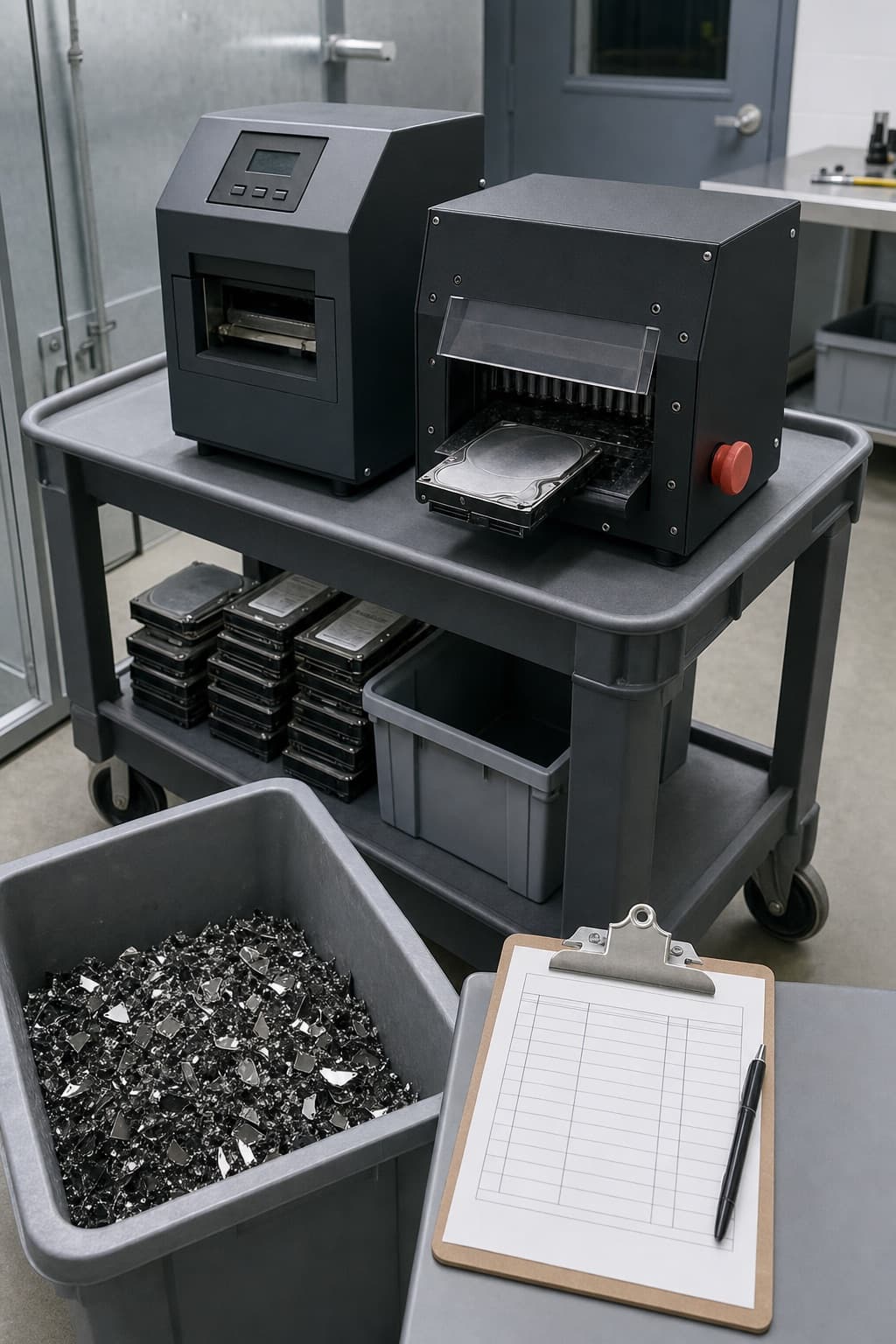
What each method actually guarantees
Certified erasure
Software overwrites the media and verifies the result, device by device. It keeps the asset resaleable, which is the entire point. It depends on the drive reporting honestly, so it needs verification and a per-serial record. When a certificate of erasure is enough, and when only destruction will do, is its own question.
Degaussing
A magnetic field destroys the data and, in practice, the drive. It applies to magnetic media and does nothing to solid-state devices, a distinction that has ended more than one audit badly.
Physical destruction
Shredding or disintegration. Unambiguous, irreversible, and it forfeits all recovery value. Particle size matters and should be specified rather than assumed.
Want this scoped for your own site?
On-site or off-site
On-site destruction means media never leaves under your custody in a readable state. It costs more, needs space and power, and slows the day. Off-site is cheaper and faster but introduces a transport leg during which the data still exists.
If transport is involved, the sealed-load procedure and the time between pickup and destruction are the two things worth specifying in writing. The other controls that make destruction secure are in what the word secure adds.
What a defensible certificate contains
- Serial numbers, device by device, not counts, not weights.
- The method applied to each device, and the standard referenced.
- Dates for each custody transfer, not just for the destruction.
- The operator and the facility where the work was performed.
- Exceptions: devices that failed erasure and what happened to them instead.
That last line is the one most often missing, and the one an auditor asks about first. The full list is on what a certificate of destruction has to contain.
Related pages
- NIST 800-88Know what the current revision asks before a vendor quotes against it.
- Certificate of destructionHold a document that survives being read.
- AboutKnow who is on the other side.
- IT asset dispositionUnderstand ITAD economics before signing.
- DecommissioningUnderstand the full sequence of a decommissioning project.
- ChecklistPrepare a project properly before consulting providers.
Define the data requirements
The data answer drives the whole scope. Describe it and the quote can be something real rather than a placeholder.
After you send it: a call back, dialed by hand, to go through the scope with you. With your agreement, the scoped request then goes to a qualified provider covering your area.