October 5, 2026 · 6 min
Secure data destruction: what the word secure adds, and where it fails
Two hundred and sixty searches a month at $3.37, the cheapest priced click on this site. The reader is not a buyer yet. They want to know what makes destruction secure, and the answer is a set of controls around the machine, not inside it.
Data destruction is what happens to the device. Secure data destruction is what happens around it: who held it, how it travelled, who watched, how the result was checked, and whether the list at the end matches the list at the start. The machine is the least interesting part. Any shredder destroys a drive. What the word secure adds is a set of controls that make the destruction provable, and each of them has a failure mode worth knowing.
Destruction without the adjective
Take the machine on its own: a drive goes in, fragments come out. Nothing about that event tells you which drive it was, whether it was one of yours, whether all of yours went through, or whether the fragments are small enough for the media type. The term itself, and what a defensible version looks like, is the subject of the data destruction article. Everything below is what has to be added to turn an event into evidence.
Custody: who has the device, at every moment
Secure starts with a manifest at the point of removal: each device scanned, its serial number, its source and the time recorded, before it moves. From then on, every transfer between people or places is documented, with a signature on each side. The purpose is that at any moment between your rack and the machine, there is a name against the device. The weak point is the first hour: devices pulled by a busy team and set aside for later, with the manifest written afterwards from memory. Custody that starts late has a gap at the beginning that no later discipline closes.
Sealed transport
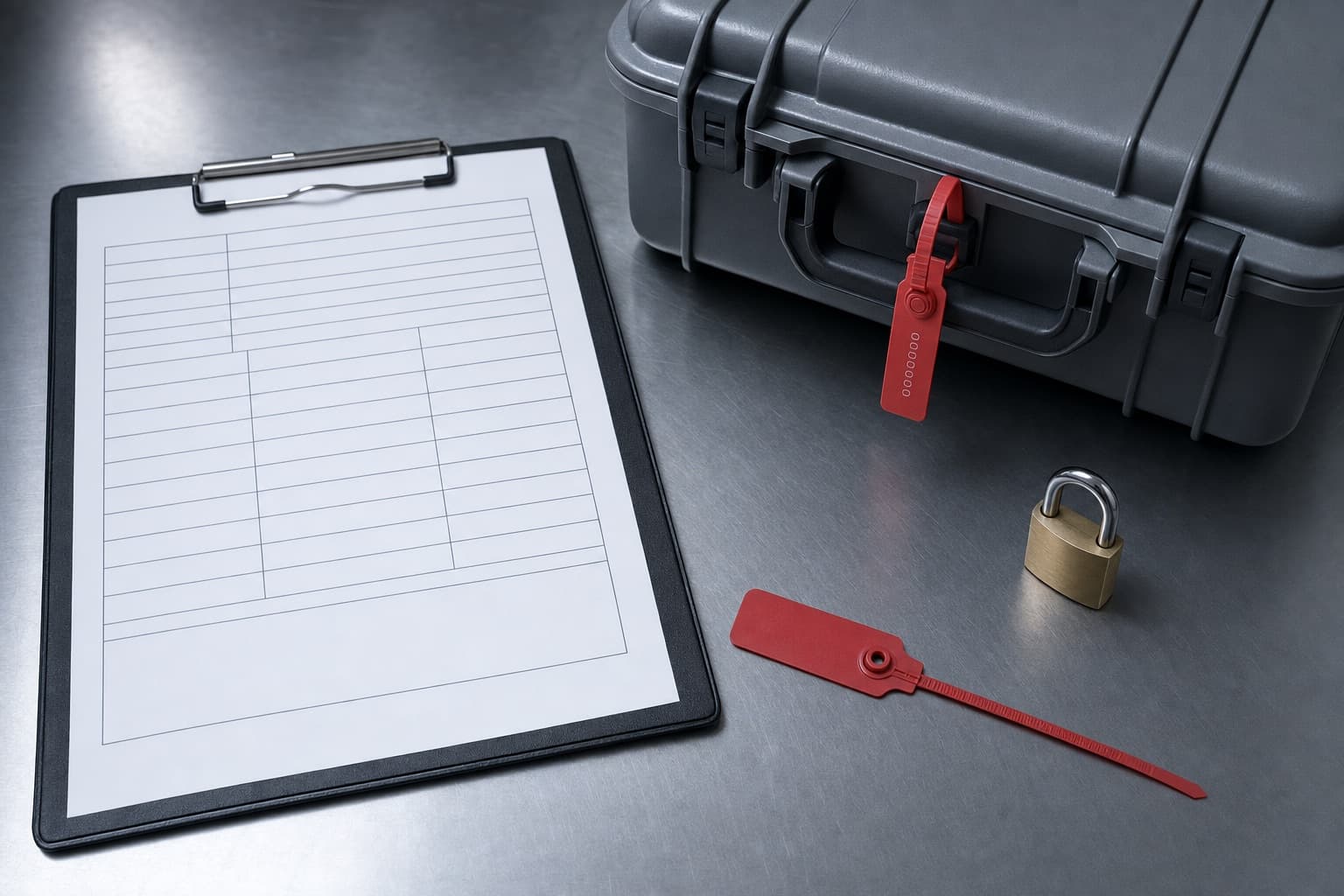
When the devices leave your site with data still on them, the containers are closed with numbered seals, the seal numbers are on the manifest, and the vehicle is under the vendor’s control from door to door. On arrival, the seals are checked before anything is opened, and a broken or mismatched seal is an incident with a written procedure. The weak points are consolidation stops, subcontracted transport, and a seal check that happens after the container has been opened. Ask who drives, whether the vehicle stops, and who inspects the seals on arrival.
A witnessed process
A witness confirms that each device on the manifest went into the machine, and signs. The witness may be your employee on your site, your representative at the facility, or a recorded process with device scans matched to the destruction event. The weak point is a witness who is present but not watching: a manager checking in between meetings, or a camera that records the room but not the serial numbers. If your policy requires the work in front of you, the practicalities are in the on-site destruction article.
Verification, not assumption
For erasure, verification means the result is read back and confirmed per device, with the failures listed and routed to physical destruction. For physical destruction, it means the output meets the particle size the media type calls for and the device serial was captured at the moment of destruction, not reconstructed. The weak point is assumed success: a tool that reports completion without confirming, or a shred bin counted by weight. Secure means every device has an outcome, and the outcome was checked.
Serial-level reconciliation
At the end, the list of devices destroyed is reconciled against the list collected, and both are reconciled against your asset register. Every line matches, or it is an exception, and exceptions are listed and investigated rather than absorbed. This is the control that catches everything the others missed, and it is the one most often skipped, because it produces uncomfortable findings. A report with no exceptions across a large estate is describing a reconciliation that did not happen.
Where the weak points are, in one list
- Devices pulled before the manifest exists.
- Transport that stops, consolidates or changes hands.
- Seals inspected after opening, or not recorded at all.
- A witness who is present but not watching serial numbers.
- Success reported by the tool and never verified.
- Reconciliation by count or weight rather than by serial number.
- A report assembled afterwards from photographs and memory.
Each of those turns a secure process back into a trusted one, and trust is exactly what the adjective was supposed to replace.
What secure looks like on paper
A manifest with serial numbers and seal numbers, handover signatures at each transfer, a witness signature or scan record per device, a verified outcome per device, and a reconciliation with exceptions listed. If a vendor can show you blank versions of each before the job, the process exists. If they cannot, the word on the brochure is doing the work the paperwork should. What each stage involves, and the documents it should produce, is on the secure data destruction page.
More advice
Ask for the blank documents, in order
Manifest, seal log, handover sheet, witness record, reconciliation. If a vendor can show all of them before the job, the process exists.
Data Center Exit is an independent reference on buying a data hall decommission. It decommissions nothing, destroys no media and holds no certifications of its own. It explains what a defensible chain of custody has to contain, which certificates are verifiable and how, and what to specify before a vendor quotes.