October 16, 2026 · 4 min
Hard drive degausser: what it erases, what it cannot, and how you verify it
A degausser wipes magnetic media in seconds and leaves nothing to read back. That is its strength, and it is also why verifying the result takes a different approach.
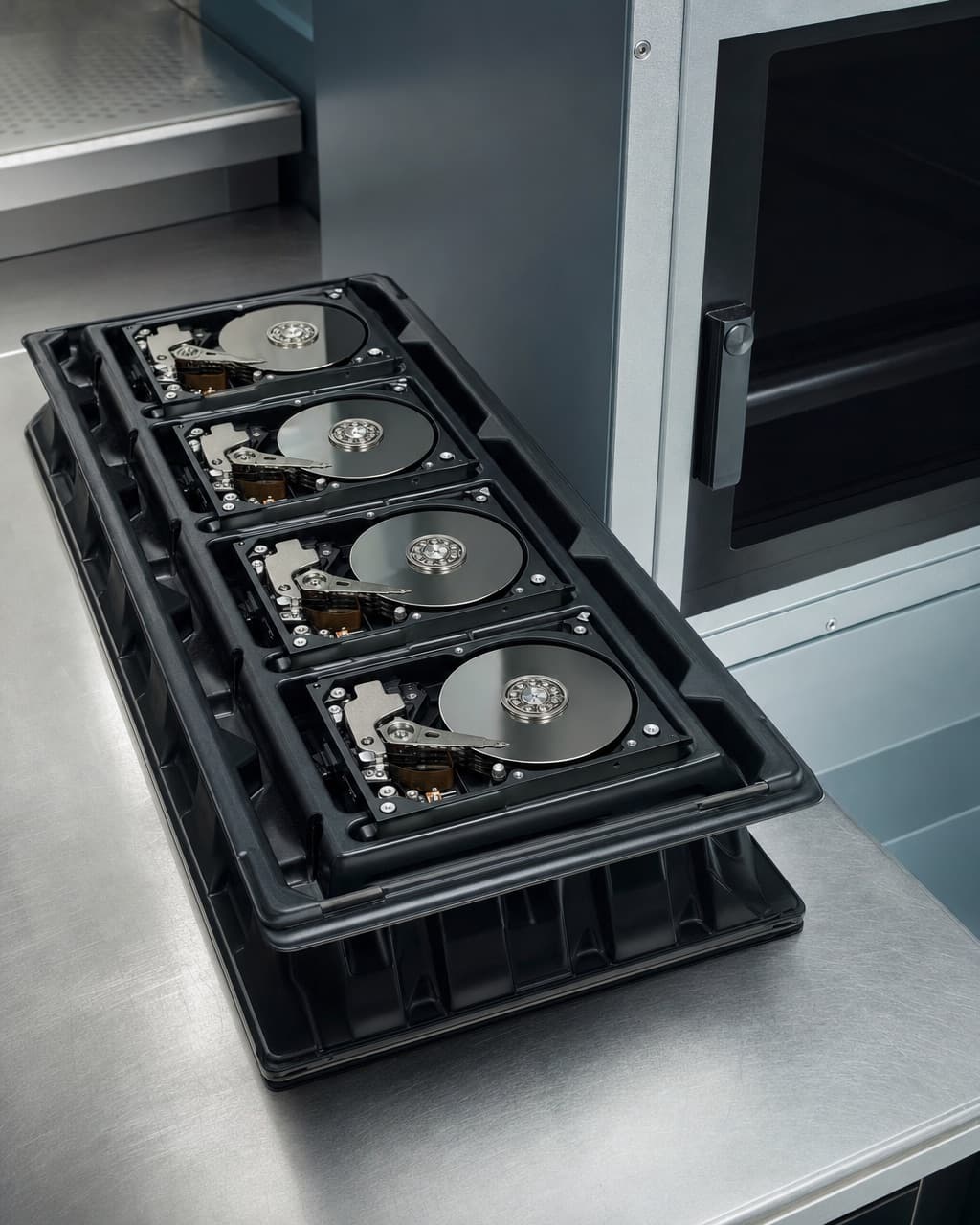
A degausser is a machine that exposes magnetic media to a strong magnetic field, scrambling the magnetic domains that hold the data. On a hard disk drive, it also erases the servo information the drive needs to position its heads, which is why a properly degaussed drive no longer works at all. For buyers comparing data destruction methods, the degausser is often presented as fast and final. It is both, for the right media.
It works on magnetic media only
Hard disk drives and magnetic tape store data magnetically, and a degausser of sufficient strength can erase them. Solid state drives, USB flash drives and memory cards store data as electrical charge in flash cells, which a magnetic field does not affect. Degaussing an SSD leaves its data intact. A vendor that offers degaussing for a mixed register of drives should explain what happens to the flash devices, as covered in destruction or verified erasure.
Field strength has to match the drive
Each magnetic medium has a coercivity, the field strength needed to change its magnetization. Modern high density drives have higher coercivity than older ones, and a degausser rated below the media’s requirement may not fully erase it. Reputable degaussers are specified for the media they handle. Some have been evaluated by government bodies, and in the United States the NSA maintains a list of evaluated degaussers. Ask which model is used and what it is rated for.
Why you cannot verify by reading the drive
After software erasure, a sample of drives can be read back to confirm that nothing remains. After degaussing, the drive does not spin up properly and cannot be read at all. Verification therefore relies on the process: the degausser’s rating, a field strength check with the indicator or test device supplied by the manufacturer, and a record that each serial number went through the machine. A drive that still works after degaussing was not degaussed.
Where the guideline places it
NIST SP 800-88 treats degaussing as a purge method for magnetic media, provided the degausser is appropriate for the media. It is not listed as effective for flash. How the guideline’s categories work is set out on NIST 800-88. A certificate that cites degaussing for an SSD is a certificate that describes a method that cannot have done what it claims.
Degaussing and shredding together
Many programs degauss drives and then shred them. Degaussing removes the data, and shredding provides visible, auditable physical evidence that the device is gone. Shredding alone leaves fragments of platter that, depending on particle size, may still carry readable data, which is why the combination is common for higher classifications. The shredding side is covered in what a shredder proves.
What degaussing costs you
A degaussed drive cannot be reused or resold. For drives with remaining value, verified software erasure keeps that value and produces a per drive verification record. Degaussing is the right choice when the classification calls for it, when drives have failed, or when the volume makes per drive software erasure impractical. It is a decision per media type and per classification, not a default.
What to see on the certificate
The serial numbers of the drives degaussed, the degausser model and its rating, the date, who operated it and, if the drives were shredded afterward, that step recorded separately. A certificate that says degaussed without naming the equipment gives you nothing to check. What a sound certificate contains is detailed on certificate of destruction.
Ask also what happens to drives that turn out to be flash or hybrid once they are opened. A process designed for magnetic disks needs an explicit route for the devices it cannot erase, or those devices end up degaussed, recorded as sanitized, and still full of readable data.
On site or at a facility
Degaussers come in desktop and mobile units, which makes on site degaussing practical in a data hall or at the loading dock. That keeps drives within your control until the data is gone, which is often the reason to choose degaussing in the first place. The trade off between on site and off site work is set out in the article on destruction or verified erasure, and the same questions apply: who operates the unit, who witnesses, and how each serial number is logged as it goes through. What the building has to provide for that is covered in on-site destruction of drives and media.
Ask which method fits each media type
Send the media types on your register. The call back sets method, category and verification per device type, ready for the provider who quotes.
After you send it: a call back, dialed by hand, to go through the scope with you. With your agreement, the scoped request then goes to a qualified provider covering your area.